It's been forever since I've done a movie review on this blog you are reading. So, while I wait for the men's Ice Hockey event to get underway (it begins tomorrow at noon), today is a good chance to get a movie in, and as you can see from the picture, today's selection is Life of Oharu.
The basic plot of the movie follows Oharu's descent from lady-in-waiting to streetwalker in 17th century Japan. The movie begins with Oharu having an unsuccessful run as a streetwalker, and from there, the viewer is treated to a lengthy flashback that starts from the lady-in-waiting phase of her life. It is there that things begin to go wrong for her and her family, as she is caught with a page, and in that time period, a higher up could not be seen mingling with a lower class. Because of that, she gets banished with her family to another town while the page simply gets beheaded. From there, Oharu has unsuccessful stints as a concubine to an Emperor, a courtesan, servant, nun, and streetwalker. Even when she finds happiness, as she does when she marries a fan maker, that doesn't last, as he gets killed by a robber soon thereafter.
Life of Oharu is a thoroughly depressing movie that touches on class rigidity and gender issues. Throughout the movie, the viewer sees Oharu having to be dependent on the male for any level of success and failure to do so only serves to complicate her living situation. The movie paces itself fairly well, but provides little in the way of excitement (for those who only seek such things). It is also a movie that provides a different view of Japan from the normal Samurai fare that dominated the Japanese movie scene in the 1950's. Ultimately, Life of Oharu peels the curtain back on an era that is typically romanticized with acts of bravery and courage and does so in a manner that demystifies the era in ways similar to Seven Samurai.
Showing posts with label Japan. Show all posts
Tuesday, February 11, 2014
Tuesday, July 16, 2013
Samurais...in Color
The movie Gate of Hell was one of the first samurai movies to be made in color, and thanks to Criterion Collection, it is now available for release. The plot:
A winner of Academy Awards for best foreign-language film and best costume design, Gate of Hell is a visually sumptuous, psychologically penetrating work from Teinosuke Kinugasa. In the midst of epic, violent intrigue in twelfth-century Japan, an imperial warrior falls for a lady-in-waiting; even after he discovers she is married, he goes to extreme lengths to win her love. Kinugasa’s film is an unforgettable, tragic story of obsession and unrequited passion that was an early triumph of color cinematography in Japan.The visuals, as in color, is glorious, and while the plot leaves a little to be desired (read: doesn't stand out from the other samurai movies released in the same time period), the last fifteen minutes or so is what really ties it all together and in dramatic fashion. There aren't any special features to speak of, but here, it isn't such a bad idea, as the movie speaks for itself.
Wednesday, January 2, 2013
Battle Royale
Not having done a movie review in a while, today is an opportunity to fix that, and today's movie is Battle Royale. The story is that a class of ninth graders are picked to participate in a killing game that only ends with one person surviving. The movie itself is based on a novel of the same name, and like the novel, the film was released to much controversy. The central characters in the movie are Shuya Nanahara (Boy 15), Noriko Nakagawa (Girl 15), and Kitano (teacher). Other central characters in the movie are Kawada (boy 5), Kiriyama (boy 6), and Mitsuko (girl 11). For purposes of this review, these are the characters that do the most in the movie, so I will focus on them as opposed to the others, most of whom have one line or two before getting killed.
The film follows Nanahara, who was orphaned after seeing his father hang himself, and Noriko, who has a special relationship with Kitano (father and daughter like relations, to be specific). Kawada and Kiriyama are transfer students with different motivations for being in this Battle Royale, with Kawada being the guardian angel of sorts for both Nanahara and Noriko while Kiriyama joins for the sport of it. Mitsuko also plays a central role in this film, as other than Kiriyama, she is the most lethal player in this game. Beyond all the killing, Battle Royale touches upon the themes of friendship, love, and relations with family gone awry. You notice these things in the flashbacks that Nanahara, Noriko, and Kitano have, and even when Kitano inadvertently (?) saves Noriko from certain death at the hands of Mitsuko. The violence within the movie will either draw you in or push you away, but it is the underlying themes that ultimately make this movie worth your time.
Tuesday, December 4, 2012
Seven Samurai
I have not done a movie review on this blog in a while, and since the lockout is hindering how much I can talk about hockey, today is a day for a movie. The three and a half hour epic known as Seven Samurai is Akira Kurosawa's most famous work and takes a lot of the glamour out of the samurai that Hollywood puts on it. The basic plot is that there is a village of farmers that need some samurais to help fend off some bandits. This leads to seven out of work samurais to band together and protect them. Up until the first battles begin with the bandits, Kurosawa focuses on the struggles that the samurais have in trying to gain the trust of the farmers, who themselves aren't exactly innocent in their dealings with past protectors. The samurais do their job, but not without paying a steep price, as one samurai notes that he has lost every battle. It becomes clear what he means at the end, when the final scene is focused on the four graves of the seven samurai who were slain in battle.
The pacing of the movie is deliberate, which may turn off some people, but Kurosawa is careful to not leave out any critical detail in the movie, something that was also present in Ikiru, a movie I reviewed earlier. If you have the time and patience, do yourself a favor and check out Seven Samurai.
Friday, September 16, 2011
New Look, Same Philosophy
The Nashville Predators underwent a major facelift this Summer, opting to modify their logo and a (much needed) complete jersey makeover. Of course, this hides nothing as far as the on ice product, which finally broke through in the playoffs, getting past the first round for the first time in franchise history. The defense first mentality is nothing if the entire team isn't committed, and that begins with Shea Weber. He was in the headlines for arbitration, so his long term future is in question. What is not in question is his on-ice ability and a slap shot from the blue line that few can match. Acquired in a trade deadline deal from Ottawa last year, Mike Fisher didn't put up the numbers expected of him. A full bill of health, as well as a full season in Nashville should put him in as one of the top threats on offense. More offense is needed, and there is a breakthrough season waiting for Colin Wilson or Nick Spaling. Safe money says go for Wilson, a former first round pick.
Prediction: 7th in West
Movie: Gamera
A giant turtle with rocket boosters. How does that compare to a team that has a saber-tooth tiger logo? Besides the animal theme? Maybe you don't appreciate either right away, but that will change in time.
Prediction: 7th in West
Movie: Gamera
A giant turtle with rocket boosters. How does that compare to a team that has a saber-tooth tiger logo? Besides the animal theme? Maybe you don't appreciate either right away, but that will change in time.
Monday, July 18, 2011
Ikiru
Yesterday, Japan won the Women's World Cup and congratulations are in order for both Japan and the United States for a great game yesterday. However, it is only a coincidence that I cover today's movie, Ikiru. The movie is a 1952 classic from Akira Kurosawa, who you will undoubtedly remember for Seven Samurai and Rashomon. This 1952 classic was in many ways, an atypical Kurosawa movie, as the central story revolves around Kanji Watanabe, who only has months left after learning he has stomach cancer. There are two parts to this movie: Watanabe trying to find meaning in his life and the people who knew him trying to make sense of his actions after his death. The main purpose of this movie is not the life and death part, as that is set in stone. Instead, Ikiru focuses on Watanabe's attempts to find a way to leave some kind of legacy for others.
There are many questions that can be picked from the movie, including why it takes a life threatening event to motivate a person to live, the state of Watanabe's relationship with his son, which seemingly was a one way street until the elder's death, and how exactly a change in hats can, if at all, change the way a man lives. The movie is in black and white (no surprise, since it was made in 1952), is in Japanese with English subtitles, which is optional (it's a good idea to watch it without, but if you must, the subtitles are there to help you along), and runs over two hours. The existentialist style in which this movie runs is obviously not for everyone, but if you have the time and patience to sit through this movie, then it is worth every second.
Tuesday, June 22, 2010
And Now For Something Completely Different...
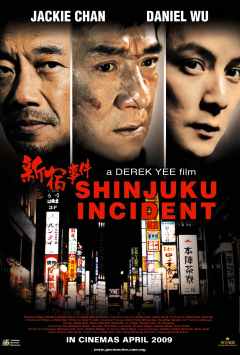
No, it's not Monty Python that I will be talking about. Instead, it is a more serious effort from Jackie Chan (Yes, that Jackie Chan) in the form of the Shinjuku Incident. Most people might not have heard of this movie, as it saw a rather limited release in the United States.
The plot of the movie is that Steelhead (Chan) has come to Japan illegally from China in search of his fiancée. He meets his "brother" and sees his fiancée with another man, which leads him to try and become a citizen of Japan legally. One incident between the "brother" and a gang leader later, Steelhead decides to take revenge and in the process, saves a different gang leader, which leads to him finding out that the fiancée is married to the gang leader he saved and has a daughter. Soon, he is head of a gang, but his ideals aren't going over well with the other immigrants that he travelled with, and a civil war breaks out.
Shinjuku Incident is a far cry from what people expect from a Jackie Chan movie, in that the action isn't nearly as abundant and the movie takes on a darker, more serious tone. This is actually one of Chan's better efforts in recent memory, as people finally get to see him outside of the norm and do so admirably. However, if you're in the U.S., you're likely going to get a badly dubbed version of this movie, so looking for the original version would be your best bet.
Wednesday, May 26, 2010
Gangsters, Zombies, and Ridiculously Big Guns. Oh, My!
Here's all you need to know about Versus: don't bother with remembering names of characters, as they don't have any, aside from the main character, who is given an identifying code similar to a prisoner (which he was in the beginning of the movie), don't try mushrooms while watching this movie (not that I recommend it), and there are lots of sword fights and ridiculously large guns. The plot? It's your basic good vs. evil plot, except that one of the characters has trouble remembering what side he is on, and a mysterious girl has to help him remember. Meanwhile, the other half of this equation is seemingly invincible, and "recruits" the dead to do some of his bidding.
The plot is kind of paper thin, and the dubbing into English sounds rather unconvincing, as both main characters could be in the path of a tornado and both sound as though nothing is happening. The fights put the entire House of Flying Daggers and Mortal Kombat movies to shame, and the zombie action isn't huge, but the blood factor is enough to satisfy horror fans. The Japanese won't be challenging the Italian horror community anytime soon, but with movies like Versus, Japan just might be worth checking out for horror movies, after all.
Subscribe to:
Posts (Atom)