It's been forever since I've done a movie review on this blog you are reading. So, while I wait for the men's Ice Hockey event to get underway (it begins tomorrow at noon), today is a good chance to get a movie in, and as you can see from the picture, today's selection is Life of Oharu.
The basic plot of the movie follows Oharu's descent from lady-in-waiting to streetwalker in 17th century Japan. The movie begins with Oharu having an unsuccessful run as a streetwalker, and from there, the viewer is treated to a lengthy flashback that starts from the lady-in-waiting phase of her life. It is there that things begin to go wrong for her and her family, as she is caught with a page, and in that time period, a higher up could not be seen mingling with a lower class. Because of that, she gets banished with her family to another town while the page simply gets beheaded. From there, Oharu has unsuccessful stints as a concubine to an Emperor, a courtesan, servant, nun, and streetwalker. Even when she finds happiness, as she does when she marries a fan maker, that doesn't last, as he gets killed by a robber soon thereafter.
Life of Oharu is a thoroughly depressing movie that touches on class rigidity and gender issues. Throughout the movie, the viewer sees Oharu having to be dependent on the male for any level of success and failure to do so only serves to complicate her living situation. The movie paces itself fairly well, but provides little in the way of excitement (for those who only seek such things). It is also a movie that provides a different view of Japan from the normal Samurai fare that dominated the Japanese movie scene in the 1950's. Ultimately, Life of Oharu peels the curtain back on an era that is typically romanticized with acts of bravery and courage and does so in a manner that demystifies the era in ways similar to Seven Samurai.
Showing posts with label classic. Show all posts
Tuesday, February 11, 2014
Thursday, August 8, 2013
Nostalgia: It's a Powerful Thing
For as much as I've been into movies released by the Criterion Collection lately, I have never found the time to delve into movies made by Ingmar Bergman (mostly due to my leaning towards the Japanese titles)...until now. I finally broke down and put on Wild Strawberries, a 1957 movie that centers around Isak Borg, a doctor who is about to receive his honorary degree from a college in Lund. However, certain events on the way there force him to assess his life and confront his relations with people in his life, which to put it kindly, is not on good terms. Driving out to Lund with his daughter-in-law, they encounter a trio of people trying to get to Italy, a bickering couple, and make a few stops at points of interest in Isak's life, namely a summer home and the house where his mother lives.
The performances in the movie are powerful, with Victor Sjostrom playing the role of Isak Borg to a tee while Bergman regulars Bibi Andersson and Ingrid Thulin provide equally strong performances in the primary supporting roles. The dream sequences that Borg has are generally tough to figure out, particularly the first sequence, but by the end of the movie, it will all make sense. The younger generation isn't likely to appreciate this movie as much as the older generation, but it will tell a story that many, if not all, can relate to and perhaps even inspire to strive for the better.
Tuesday, July 16, 2013
Samurais...in Color
The movie Gate of Hell was one of the first samurai movies to be made in color, and thanks to Criterion Collection, it is now available for release. The plot:
A winner of Academy Awards for best foreign-language film and best costume design, Gate of Hell is a visually sumptuous, psychologically penetrating work from Teinosuke Kinugasa. In the midst of epic, violent intrigue in twelfth-century Japan, an imperial warrior falls for a lady-in-waiting; even after he discovers she is married, he goes to extreme lengths to win her love. Kinugasa’s film is an unforgettable, tragic story of obsession and unrequited passion that was an early triumph of color cinematography in Japan.The visuals, as in color, is glorious, and while the plot leaves a little to be desired (read: doesn't stand out from the other samurai movies released in the same time period), the last fifteen minutes or so is what really ties it all together and in dramatic fashion. There aren't any special features to speak of, but here, it isn't such a bad idea, as the movie speaks for itself.
Monday, June 3, 2013
The Wonderful (and Wacky) World of Oz
Before I get to the subject of today's piece, I'd like to apologize for not putting in my preview for the NHL Conference Finals (though I did file one for a playoff pool I compete in annually). For those interested in knowing who I picked, I have Kings in 7 and Penguins in 6.
Now, today is a book review by L. Frank Baum, who is most famous for writing the book that was made into the movie The Wizard of Oz. The book, which is actually titled The Wonderful Wizard of Oz, would end up being the first of a 14-part series that Baum would write in his lifetime.
If you know the movie version, then you pretty much know what to expect from the book. However, there are parts that aren't in the movie that are in the book, most notably the foursome's travel to the southern part of the magical land. The book isn't anything truly special (read: not as engaging), but it is an easy read, so reading this book to children is something that you can do (if you have any). Recommended more as a story to read to kids than on your own.
Tuesday, April 2, 2013
Badlands
In light of its recent release by the Criterion Collection, today is a movie review in the form of Badlands. The basic synopsis is as follows:
The plot itself is rather basic and doesn't really have any exciting points to speak of, but where Badlands gets its notoriety is the way in which both Sheen and Spacek act throughout the movie, which is to say rather detached from the reality that they occupy. Spacek's character narrates the movie, which reflects this detachment from everyday life and almost lends a dreamlike quality to the movie. Everything lends itself to the rather laid back nature of the movie, from the scenery to the music, and even the killings themselves, which for all intents and purposes, isn't all that violent. Badlands is a movie that works well when the viewer is not watching with an emotional investment in how things go.
Based on the Starkweather-Fugate killing spree of the 1958, in which a fifteen-year-old girl and her twenty-five-year-old boyfriend slaughtered her entire family and several others in the Dakota badlands.The movie stars Martin Sheen as Kit, whose overall demeanor and looks could be mistaken for James Dean, something that is referenced in the movie, and Sissy Spacek as Holly, three years before her breakout role in Carrie.
The plot itself is rather basic and doesn't really have any exciting points to speak of, but where Badlands gets its notoriety is the way in which both Sheen and Spacek act throughout the movie, which is to say rather detached from the reality that they occupy. Spacek's character narrates the movie, which reflects this detachment from everyday life and almost lends a dreamlike quality to the movie. Everything lends itself to the rather laid back nature of the movie, from the scenery to the music, and even the killings themselves, which for all intents and purposes, isn't all that violent. Badlands is a movie that works well when the viewer is not watching with an emotional investment in how things go.
Tuesday, December 4, 2012
Seven Samurai
I have not done a movie review on this blog in a while, and since the lockout is hindering how much I can talk about hockey, today is a day for a movie. The three and a half hour epic known as Seven Samurai is Akira Kurosawa's most famous work and takes a lot of the glamour out of the samurai that Hollywood puts on it. The basic plot is that there is a village of farmers that need some samurais to help fend off some bandits. This leads to seven out of work samurais to band together and protect them. Up until the first battles begin with the bandits, Kurosawa focuses on the struggles that the samurais have in trying to gain the trust of the farmers, who themselves aren't exactly innocent in their dealings with past protectors. The samurais do their job, but not without paying a steep price, as one samurai notes that he has lost every battle. It becomes clear what he means at the end, when the final scene is focused on the four graves of the seven samurai who were slain in battle.
The pacing of the movie is deliberate, which may turn off some people, but Kurosawa is careful to not leave out any critical detail in the movie, something that was also present in Ikiru, a movie I reviewed earlier. If you have the time and patience, do yourself a favor and check out Seven Samurai.
Thursday, August 30, 2012
Blow-Up
The 1966 movie Blow-Up is not what it seems. Throughout the movie, there is a lot more than the 60's London Mod style and murder mystery. Though the movie has Vanessa Redgrave and Sarah Miles as the headlining stars of the movie, the reality is that both only really have a quarter of screen time combined. As for the real main lead, played by David Hemmings, he is a photographer that while developing pictures from a park, believes that he may have captured a murder. Yet, for director Michelangelo Antonioni's part, he doesn't even begin to focus on the murder, but rather Hemmings' slow descent into a world where the line between reality and illusion gets blurred little by little. The mimes at the beginning and end of the movie are a metaphor for the invisibility that Hemmings' character feels as he tries prodding at what really happened in the park.
Blow-Up is a deliberately paced movie that benefits from the soundtrack of Herbie Hancock and sounds of quiet during the park scenes. If you pay attention, you may spot the Yardbirds playing during a scene, which means you get to see Jeff Beck and Jimmy Page (pre-Zeppelin).
Wednesday, June 6, 2012
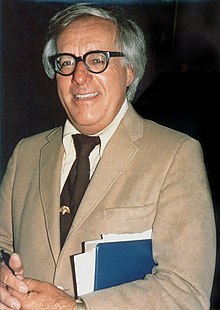
Ray Bradbury
As mentioned in the Vladimir Krutov piece, today hasn't been a good day when it comes to significant people dying. What Krutov did for Russians who aspired to play in the NHL, Ray Bradbury did for the science fiction genre in books. Bradbury's most well known works include The Illustrated Man and Fahrenheit 451. It was Bradbury's fear of technology that propelled many of his stories, with Fahrenheit 451 providing great relevance, even today, in the wake of e-readers emerging and books like Fahrenheit 451 being on the banned list. Bradbury was 91.
Thursday, April 12, 2012
The Illustrated Man
Playoff hockey began last night, and not in the manner in which I had hoped. It's a long journey, and panic is only an option during an elimination game. Today, however, is a book review and today's book was discovered in a Goodwill Store in Portland, OR. Imagine my surprise when The Illustrated Man by Ray Bradbury came across my face for just a dollar. That's right, a classic for just a measly dollar. Having enjoyed Bradbury's other classic Fahrenheit 451, and the price in which I would have to pay for another book, I had nothing to lose. You know where this is going, so read on...
The Illustrated Man is eighteen short stories by Bradbury that are tied together by the fact that they are being told on the back of a man who is tattooed all around. The catch here is that the man's tattoos tend to come alive at night, and generally frighten those who see them. Many of the short stories tell about the dangers of the future and reliance on technology. Some favorites from the book include "The Long Rain," which is about travelers trying to find a Sun Dome on Venus, "The Exiles," which is similar to Fahrenheit 451, only that the spirits of the authors get exiled to Mars and plot their revenge, and "The Other Foot," a story about what happens when racism gets out of control. Many of the stories are distinctly Bradbury, and though there isn't much time spent on the Illustrated Man or the unnamed traveler (later versions will likely have something tacked on), the book is worth a few reads...at any price.
Friday, January 20, 2012
A Clockwork Orange
Today's review is actually a double, as in both a movie and book review of the same thing. As you can tell from the title, today is about A Clockwork Orange, a novel by Anthony Burgess that was later made into a movie by Stanley Kubrick. The story behind A Clockwork Orange is that the main character Alex is telling his story of how he went from the de facto leader of a small gang to a proverbial sacrificial lamb for the Ludovico Technique and back to "normal." The book actually has one more chapter added than what most American readers are used to, something that Burgess had in the beginning, but due to his American publisher's demands, had to cut the chapter out (the last one). The novel paints a dark, unforgiving world that points out some social commentary. The narration is in "Nadsat," a variation of Russian mixed with English, with influences from Cockney slang and the King James Bible. After a while, the narration can get a little annoying, but it doesn't take away from the basic story, and one of the most endearing aspects of the novel is that it forces deep thought from the reader. Many questions arise from the novel, many of them of the moral variety.
The movie stays mostly true to the novel, with a few exceptions. Where the movie differs the most from the novel is that it becomes a little more of a dark comedy (e.g. the rape scene where Alex sings "Singing in the Rain" while doing so) and relies heavily on the use of color, particularly in Frank Alexander's residence. The bright scenery in many respects clashes heavily with the overall message, which unintended or not, provides something for those who place great value on visual aspects while keeping the main story as the focus. The movie is considered a cult classic for good reason: it portrays the novel as close to perfect as it can, and it helps that Malcom McDowell's portrayal of Alex ended up being perfect.
Thursday, November 10, 2011
Sucked into the Tube
From the mind of David Cronenberg, the guy that brought you Scanners, comes a techno-fear inducing movie in Videodrome. The 1983 movie centers around the head of a television station Max Renn that puts on sleazy programming. One day, with some help from one of his employees, he finds something called Videodrome, which broadcasts torture victims in what appears to be a clay colored room. The reality of the Videodrome is something far sinister, as Renn finds out. After the disappearance of his girlfriend (Deborah Harry, yes that Deborah Harry of Blondie fame), Renn tries to find answers about the mysterious station, and soon, changes to his physical being begin to emerge, including a development of a vagina-like VCR in his midsection.
The movie itself was ahead of its time when it comes to special effects, and the social commentary within the movie isn't too strong, yet will make you think twice about technology, and television in particular. This movie isn't for everyone, but it is definitely one of those movies that once you get it, you get it.
Sunday, October 23, 2011
Nightmare Fuel
Today's movie is the 1962 release of Carnival of Souls. This is not to be confused with the 1998 version, which has almost nothing to do with the original version. The 1962 version actually has a wider release now thanks to Criterion, but the version that was pushed in front of my face was actually distributed by a company called Good Times DVD, and somehow made its way to a GameXchange dollar bin. As for the movie, it was shot on a $33,000 budget, and stars Candice Hilligoss as the main character Mary Henry, who is the sole survivor in a car crash that kills two of her friends. Some time later, she is an organist in Utah that begins to see "The Man" in reflections after passing a deserted pavilion Soon, the images begin to haunt her, and she begins to wonder if she is alive or dead, as the surrounding people's ability to acknowledge her fades in and out at times. The ending will definitely surprise you. The scare factor relies on the music of the movie, which is great in that it adds to the overall psychological horror that was intended. As for death scenes, outside of the car crash in the opening sequences, there isn't much to speak of, but Carnival of Souls was built on mental scarring, not physical, and that is what makes this movie worth seeing.
On an interesting side note, parts of this movie was made in the Lawrence, KS area, so anyone in the Kansas City/Lawrence area, this would be a decent pick up for the local enthusiast in your life.
Tuesday, July 26, 2011
Insane Asylum
Book reviews can often happen at an irregular pace, and certainly, this blog's curator is no exception when it comes to that. However, since I have in fact finished a book (after three months), I can grace this blog with yet another book review. Today's selection is not only a great book, but it was also turned into an equally great book (Some say the movie is better than the book, and in the rare instance, it is true here). The Ken Kesey novel One Flew Over the Cuckoo's Nest is told through the eyes of Chief Bromden, who happens to be an inhabitant of the Asylum that is headed up by the Big Nurse, who keeps everything in order. However, that all changes when Randle Patrick McMurphy enters the asylum from a prison work program. Soon, it becomes a war of wills between the Big Nurse and McMurphy for control of the ward members.
The mechanical nature in which the asylum is run is told in such a way that the asylum is more of a machine factory than an actual insane asylum. The slow turn in which the inmates soon go from weak-minded to free-thinking is just that: slow, which furthers the McMurphy/Big Nurse storyline that builds to a fairly big finish. While the movie version gets all of the recognition (and rightfully so), the book is underrated in its narrative that presents a cold, sterile atmosphere.
Thursday, July 21, 2011
Evil Dead II
From the minds of Bruce Campbell and Sam Raimi comes a movie that is considered a horror classic. Evil Dead II is the sequel to one of the scariest horror movies in American Cinema Evil Dead. The sequel wraps up the loose ends to the first movie while setting up what would eventually be the third and final movie in the series Army of Darkness. The second movie isn't nearly as scary as the first and not as quote friendly as the third movie, but what it can claim to be is the perfect movie in the sense that it combines the two and maintains a balance that few movies can claim. Evil Dead II also has some hilarious moments that would carry over onto Army of Darkness. Whereas many people claim Evil Dead II to be a classic, it's just another day at the office for Bruce Campbell, who simply makes movies that people will be talking about for a long time.
Monday, July 18, 2011
Ikiru
Yesterday, Japan won the Women's World Cup and congratulations are in order for both Japan and the United States for a great game yesterday. However, it is only a coincidence that I cover today's movie, Ikiru. The movie is a 1952 classic from Akira Kurosawa, who you will undoubtedly remember for Seven Samurai and Rashomon. This 1952 classic was in many ways, an atypical Kurosawa movie, as the central story revolves around Kanji Watanabe, who only has months left after learning he has stomach cancer. There are two parts to this movie: Watanabe trying to find meaning in his life and the people who knew him trying to make sense of his actions after his death. The main purpose of this movie is not the life and death part, as that is set in stone. Instead, Ikiru focuses on Watanabe's attempts to find a way to leave some kind of legacy for others.
There are many questions that can be picked from the movie, including why it takes a life threatening event to motivate a person to live, the state of Watanabe's relationship with his son, which seemingly was a one way street until the elder's death, and how exactly a change in hats can, if at all, change the way a man lives. The movie is in black and white (no surprise, since it was made in 1952), is in Japanese with English subtitles, which is optional (it's a good idea to watch it without, but if you must, the subtitles are there to help you along), and runs over two hours. The existentialist style in which this movie runs is obviously not for everyone, but if you have the time and patience to sit through this movie, then it is worth every second.
Monday, January 31, 2011
Frankenstein
I haven't done a book review in a while, and since the book I'm currently reading is still about 150 pages or so away from finishing, I thought it would be a good idea to take a look at something I read a couple of years ago...after showing little interest in reading it as part of a college class. Yes, the book in question is Mary Shelley's Frankeinstein. Before I get into the book, I'd like to say that reading books in the post-college years has come rather easily. I suppose it's due to not having to deal with time constraints and trying to determine what has to be picked out for quizzes and essays, all of which likely takes me out of the running to be a teacher some day.
The novel is told through the eyes of Dr. Victor Frankenstein, who as we find, is on a ship heading north. For what exactly, the reader will find out in the end, so read the entire thing, since I'm giving no spoilers here. The basis of the story concerns Dr. Frankenstein and his want to recreate life in an inanimate life. His studies take him to the point of creating a monster made from various human parts. However, after the creature comes to life, Dr. Frankenstein becomes disillusioned with it, and abandons it. This does not sit well with the creature, who proceeds to kill everyone Dr. Frankenstein loves until the final encounter.
One of the first true horror novels to be written, Frankenstein spares no detail when it comes to how things come together for the creature and captures Dr. Frankenstein's descent into insanity quite well. At roughly 200 pages long, it's a relatively quick read that offers a lot in terms of the emotion and atmosphere that some of today's novels lack.
Sunday, December 5, 2010
Rural Misdeeds
It's been a while since I've done something other than hockey on this little blog, and even longer since I've done a movie review. So, to change that a little, here is a 1972 giallo from...Lucio Fulci? Before I go on, it should be noted that before Zombi 2, City of the Living Dead, and The Beyond, Fulci started out experimenting with the giallo subgenre. Two of the movies that he directed can be considered solid works: New York Ripper and the subject of today's piece, Don't Torture a Duckling.
The basic premise of the movie is that a few boys in the rural village are turning up dead, and the people of the village and the police are baffled. It is up to a reporter (sporting a 70's porn 'stache) and a sexually active woman to find out who is committing the murders. Unlike most gialli, Fulci relies more on natural lighting to create the desired effect of fear. The violence level isn't too much, but there are some spectacular moments, such as the Gypsy woman getting beaten with chains, and the end scene. The overall effect of the movie is far greater than the parts that make up the movie. Don't Torture a Duckling is a worthwhile movie that is comparable to some of the better giallo movies in that time period.
Wednesday, October 27, 2010
And Now For Something Completely Different...A Comedy
Ever since I began this blog that you read (or don't read) on a weekly basis, much of the talk has been about hockey, horror movies, and just the love for metal music. Today, I will take a small detour into some comedy, and today's movie is actually familiar territory for me, since Monty Python is considered a staple in anyone's laugh repertoire.
Life of Brian was one of the movies that the Monty Python troupe made and offers their take on the times in which the Romans and Jews were in a struggle for control. If you know your religion studies at all (Christian or not), then you'll get what is going on. The movie follows a guy named Brian, who spends his entire life being mistaken for the Messiah, as evidenced early on by the Three Wise Men visiting his place as a baby. His place just happens to be next door to the real Messiah, which explains the Wise Men taking back the gifts. Those who take their religion seriously need not apply here, since the movie skewers the idea quite a bit.
While Life of Brian isn't on the level of Monty Python and the Holy Grail, the movie more than holds its own when it comes to laughs. And no Monty Python movie would be complete without quotables and a memorable song:
Friday, October 22, 2010
Accept the Saxon-Head
Halloween is just around the corner, and movie watching has actually been down compared to the April movie marathon. It also means that hockey season is in full swing and rubbing rabbit's feet that the Portland Trailblazers can stay healthy for a full season. Today's movie is from the son of Mario Bava, Lamberto, and is his signature movie Demons.
The movie is about people who get an invitation from a mysterious figure (Michele Soavi, which means you should take a shot, as per the rules of the "Spot Michele Soavi" drinking game) for an unidentified movie in a theater that no one has heard about until that evening. The central figures in the movie are two young girls who skip class to attend, and two guys who meet up with them at the theater. If you have seen The Church at all, then you will know where it borrows much of its story from, as Demons soon sees the people in the theater looking to not get infected and turn into a demon. The source: a mask that somehow causes a cut on the person's face who wears it, if only for a few seconds. As for the movie within a movie, it further illustrates this point, as the events of the movie soon get replicated within the theater. Survival and trying to stay uninfected are the ideas for the movie, and it works to a large degree. Demons borrows from Cat O'Nine Tails (blind man has his assistant tell him what is going on in the movie) and Suspiria (the use of color in the movie) to great effect, and it figures, since Dario Argento had a hand in this movie. The gore in this movie is great in quantity and quality, though there are instances of the "turning into one of them" where you wonder if they grow really bad boils. The main characters aren't too annoying, and the state of panic is done well, as the feeling of being unable to escape, with the exits concreted and bricked off, turn the movie into one LSD-induced nightmare (not that I recommend doing that kind of thing). Of particular interest is the usherette, who stands out just for sheer beauty.
The soundtrack is heavy metal laden, which sets a template for Opera, which was Argento's next movie, and fits in with some of the movie's best scenes. Demons takes the best parts of some of Italian horror's best movies and makes it equally, if not better.
Wednesday, October 13, 2010
The Three Ring Circus Mall
Zombies have been (some of) the rage lately, with zombified novels and of course movies. None of this would be possible without the work of one George A. Romero. Whereas Night of the Living Dead started it all, it was his second zombie film Dawn of the Dead that established the parameters for how to deal with a zombie invasion and how zombies should act in a movie, that is, if zombies can get it through their nonexistent brains.
As with any Romero film, there is social commentary in the film, with the zombies gravitating towards a shopping mall in this film. The main characters are a helicopter pilot, his girlfriend, and two soldiers, who escape a zombie invasion and find refuge in a mall. For a while, the four fight off the zombies while trying to make some kind of living in the mall before the rigors of fighting off the zombies gets to one of them and he becomes one of them. A biker gang disrupts the living, which naturally causes chaos within the mall. Most of the gang becomes zombie food, and eventually, the surviving main characters have to flee the mall in the helicopter.
It was in this movie that the best way to deal with them is to shoot them in the head or sever the head from the rest of the body. Also in the movie is some of the worst zombie makeup ever, which to be fair, wasn't established, since Romero was still trying to figure it out. I never said this was a perfect zombie movie. Even with the social commentary, there are some light-hearted moments such as the zombies trying to use the escalator and sometimes falling, and the biker gang trying to use practical jokes such as spritzer water and pies in the face of zombies. I don't know about you, but pies in the face are good for baseball players, but zombies won't take too kindly to that sort of thing.
Yes, there was a remake of this movie, which I absolutely refuse to watch, and yes, the rules established in the movie have since, been broken (by Romero, no less, in Day of the Dead, which by the way, offers more social commentary and a reason for breaking the rules here, so he gets a pass here). However, there are few zombie movies that are essential viewing like Dawn of the Dead.
Subscribe to:
Posts (Atom)