It had been a long, strange year for John Howard Scott, who was suddenly thrusted into the spotlight around this time last year, when he was voted into the NHL All-Star game by fans, only to be traded a few days later and the subsequent chain of events that followed that would ultimately see him be in the All-Star Game that year and win the game's MVP honors. His autobiography, A Guy Like Me, written with the help of Brian Cazeneuve, tells of a big kid at heart who simply wanted to enjoy the game he loved.
From his early days to his struggle with being the tall guy in pee-wee hockey, he tells of a guy who truly is like any other person, right down to their struggles. His time at Michigan Tech, which had obstacles both on the ice (the team was never any good while he was there) and off the ice (he served time for DWI), is documented, as well as how his relationship with his now-wife evolved from the awkward beginnings to where it is now, are covered. Also included is his relationship with former teammate Derek Boogaard and how he had wished he could have done more, coaches who he loved playing for, and of course, the drama leading up to his All-Star turn. Scott may be retired now, as he announced it a couple months ago, but the mark he left on the game, however small it may be ultimately, won't soon be forgotten.
One of things that makes A Guy Like Me a great read is that everything you read is truly from the heart of Scott. Despite never being comfortable in the spotlight, the reader always got the sense that no matter the situation, he manages to get through, and throughout the book, he gives thanks to his wife. Another positive of the book is that he offers a side of some of hockey's more notorious villains (that does depend on which team or teams you root for) that most fans never get to see, and while he doesn't completely throw a few people under the bus, he does address a few of those critics in a respectful manner. The book may not be as detailed as some would like, but it is one of the most honest autobiographies one will read.
Showing posts with label book. Show all posts
Wednesday, January 25, 2017
Saturday, January 25, 2014
Crossing the Line
On the heels of finishing the Bobby Orr autobiography Orr: My Story, it seemingly only makes sense that the Derek Sanderson autobiography Crossing the Line: The Outrageous Story of a Hockey Original should have been the next read. Well, I did get to reading the book, but not before reading two books before then. It should be no surprise that Sanderson's book has more details than what Orr provided in his book, as Sanderson was the outspoken, fast living yin to Bobby Orr's soft-spoken yang. Where Sanderson takes you in the book is what happened when he allowed a reputation of his own building to spiral out of control, and he lets it all out here. From drugs to living as a homeless man in Central Park for a short time to squandering a fortune, he goes to every corner of his life to provide the reader with a view of life from someone who has pretty much seen it all. Towards the end of the book, he also provides some life lessons and how he has used them to propel him into ventures such as public speaking and money management for future clients (the latter, undoubtedly something that he takes pride in, as he himself did not do great when he was playing in the NHL). The writing style, particularly some of the short antecdotes he provides, is somewhat disjointed, as it goes into one thing and then suddenly shifts to another part. Of course, perfect writing style isn't something one would expect of a self-described "third line center."
Crossing the Line is a definite must read for any hockey fan, and is a highly recommended that works best in tandem with Orr's autobiography.
Wednesday, January 1, 2014
Orr: My Story
It's been a long time coming, but Bobby Orr finally put out an autobiography that was one of the more hyped in recent memory. Most folks know the Bobby Orr that scored the Cup winning goal in 1970, and certainly, the photo that immortalizes that is evidence of that. However, Orr makes it clear that his life story is more than just that moment in time, and in the close to 300 pages that the book takes up, he takes the time to acknowledge those who helped him along the way and even the points in which he admittedly went astray.
In every chapter, Orr tells of how hockey, in some way, shape, or form, helped him out in life, yet he does not go out of his way to say that it was his life, only a part of it. He even addresses two people who one way or another affected his life, whether it was good (Don Cherry) or bad (Alan Eagleson). He pulls no punches on any subject that gets talked about, and after reading the book, it becomes clear that Orr is trying to get people to be more vigilant in their lives, and he sums that up with the two Rs: respect and responsibility.
Overall, while the bio may be a little on the short side, and certainly, there were other things that he could have talked about, Orr: My Story is worth a read.
Friday, July 26, 2013
I Got Moorcock to Review
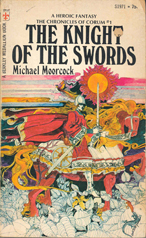
The vivid imagery of a universe not seen to the human eye is one of the trademarks of author Michael Moorcock, and he proves it once again with the first in a series surrounding the character Corum. The first book in that series The Knight of the Swords follows the beginnings of Corum, who would be the last of the Vadaghs to survive, thanks to a slaughter of his folk at the hands of the Mabden, the Moorcock equivalent of what everyone refers to as the humans. Taking an eye and a hand from the Gods, two things that Corum was robbed of in his torture by the Mabden, he seeks out the heart of Arioch in a quest for vengeance. The story isn't the star of the book, though it does provide some compelling moments, as the imagery that Moorcock provides in each of the worlds presented is larger than life and often stirs the imagination, something that a good book should do every time out.
Friday, June 21, 2013
A Book Review...Right Here on Pucks and Rocks *cheers*
That cheap pop out of the way, you likely guessed that this is a book review, and the book in question is by a guy that makes a living out of cheap pops, Mick Foley. The follow-up to the wildly popular Have a Nice Day is Foley is Good: And the Real World is Faker than Wrestling, which doesn't feel as long to read as the first book, simply because it only covers the time period from when he won his first WWF title in December 1998 through 2001. That said, Foley maintains what made Have a Nice Day on the follow-up and even has some candid moments where he talks about how the Royal Rumble match from 1999 with The Rock led to a strained friendship for a time, as well as the attacks from parent watchdog groups out to put pro wrestling out of business. If you enjoyed Have a Nice Day, then you will definitely enjoy Foley is Good.
Monday, June 3, 2013
The Wonderful (and Wacky) World of Oz
Before I get to the subject of today's piece, I'd like to apologize for not putting in my preview for the NHL Conference Finals (though I did file one for a playoff pool I compete in annually). For those interested in knowing who I picked, I have Kings in 7 and Penguins in 6.
Now, today is a book review by L. Frank Baum, who is most famous for writing the book that was made into the movie The Wizard of Oz. The book, which is actually titled The Wonderful Wizard of Oz, would end up being the first of a 14-part series that Baum would write in his lifetime.
If you know the movie version, then you pretty much know what to expect from the book. However, there are parts that aren't in the movie that are in the book, most notably the foursome's travel to the southern part of the magical land. The book isn't anything truly special (read: not as engaging), but it is an easy read, so reading this book to children is something that you can do (if you have any). Recommended more as a story to read to kids than on your own.
Friday, April 5, 2013
Hollywood's Skeletons in the Closet
Ray Bradbury is best known for novels such as Fahrenheit 451 and The Illustrated Man, and for good reason. The book that I am reviewing today is not so well-known, and after reading it, it's safe to say why. Graveyard for Lunatics is centered around a nameless protagonist who had just been hired by a film studio and receives a mysterious invitation to a graveyard. What follows is a terrifying discovery that thrusts him into a maelstrom of intrigue and mystery -- and into the dizzy exhilaration of the movie industry at the height of its glittering power. Whereas the plot of the story is quite intriguing and pulls the curtain back on the goings on in Hollywood at the time (the story is set in 1954), there are far too many twists and turns that lead nowhere and too many characters to keep up with at certain spots in the novel. The ending feels rather convoluted, as it tries to explain all of the turns, but doesn't quite make them satisfactory enough for the reader. Graveyard for Lunatics is good on paper, but it doesn't offer enough to keep the reader long enough, and in some cases, takes forever to finish.
Saturday, March 9, 2013
More B-Movie Madness
Just when you think it's safe to watch another B-movie, Alan Spencer returns with B-Movie Attack, the sequel to the wild B-Movie Reels. And just like the first book, you can expect a lot of gore and many outrageous movie characters coming to life.
B-Movie Attack picks up where B-Movie Reels left off, only this time the main characters are a down-on-his-luck director, a parking meter maid, his live-in girlfriend, and his best friend. The scene also changes from a small town in Kansas to Chicago, where the possibilities grow, and the characters that survived from the first book (flying lesbian vampires, in case you're asking) devise a plan to put the living on the same level as the dead. It starts with the director playing one of his movies, and soon, flying lesbian vampires, a deranged baker, zombie construction worker with bulldozer, and several psychotic schoolgirls with weapons such as maces and axes, among other movie creatures come to life and begin taking out the citizens of Chicago. It is up to the director, parking meter maid, and his friends to stop the monsters from killing off Chicago before it is too late.
Alan Spencer follows the formula from B-Movie Reels and adds to it on B-Movie Attack, which is no easy task, considering that Chicago is much larger than Anderson Mills, KS (the scene of B-Movie Reels). Yes, the reason for the movie characters attacking the living is a little convoluted, but it falls in line with just about any B-movie you can think of, right down to the hokey logic. The gore is certainly there, and it is actually amplified in this novel, as Spencer gets outrageous with characters such as a guy who has his intestines attack people and a 500 foot hooker (undoubtedly inspired by an actual movie). If you enjoyed the first book, then you will enjoy B-Movie Attack, and even if you're unfamiliar with either book, if you watch a lot of B-movies, then reading the books should be high on your list.
Tuesday, January 15, 2013
Straight Shootin' J.R.
Jeremy Roenick was known as a hard working, tough hockey player that didn't meet a microphone that he didn't like in his playing days, and certainly, there's no microphone that he won't turn down now that he's an analyst on NBC Sports' hockey shows. So, it should be no surprise that he has an autobiography out in J.R.: My Life as the Most Outspoken, Fearless, and Hard Hitting Man in Hockey (published by Triumph Books in the U.S., and is under a different title and published by Harper Collins in Canada). The autobiography, written with some help from USA Today columnist Kevin Allen, is an earnest look into the life of a player that either you loved or hated, and sometimes both at the same time.
Some of the highlights in the book include his insight into a locker room when he first started out, his often contentious relationships with his coaches, and addressing some of his comments from his current job as an analyst concerning Patrick Marleau and a hit on Kris Letang by Eric Nystrom last season. Though there are instances where I think he could have gone further in depth such as his early childhood, there are some that he talks about in depth that define Roenick as a man, such as his relationship with his wife Tracy and how certain players have influenced his style such as Gordie Howe, Mark Messier, and Mike Modano. The book also offers a different point of view on people such as Mike Keenan and Wayne Gretzky, both of whom Roenick as respect for, but as you read, wasn't always a 24/7 deal.
When reading the book, Roenick challenges you to think and to ask, in his words, "What the $%&* was Roenick thinking?" There were plenty of instances of the latter, and certainly many of them will have you laughing along or shaking your head. The autobiography is definitely a must-read if you're a fan of Roenick, want to know what was going on behind the scenes, or just want to have a good laugh. Be warned, as Roenick pulls no punches here.
Monday, June 11, 2012
B-Movie Madness
What if I told you that you could have a movie or book that features atomic locusts, a mallet-toting killer, a butcher that carves up more than just cows and chickens, and a Mr. Freeze clone? Thanks to Alan Spencer, this is all possible, thanks to his most recent novel B-Movie Reels.
The basic plot is that recent film school graduate Andy Ryerson moves into his uncle's house in Anderson Mills, KS. His task while there is to watch a stack of B-movies given to him by his professor and make commentary on each one. Two problems: the house has had a "storied" history, and when the original film projector breaks, Andy comes across another film projector in the house. Not long after he starts watching the movies on the antiquated projector, the characters in the movie begin coming to life and the townsfolk of Anderson Mills begin to be killed off by the various creatures and characters from the movies.
In getting to the Andy Ryerson character and the house he would inhabit, the novel offers a little back story on the house and its previous inhabitant, James Ryerson, who happened to be Andy's uncle. Here, while the novel offers a good story behind James and how the house affected him, it doesn't quite go into the inhabitant before that and why the house became the way it did until about halfway into the story. All that said, the real stars of the novel are the various creatures that emerge from the movies Andy is watching, and as is the case later in the novel, not watching, as the creatures (zombies from a movie Andy was watching) eventually take control of the projector. Many of the townsfolk are merely fodder, as they're there to be killed off, but the ones that do play a role in the story either have some kind of connection to the Ryersons or are used by the spirit of James to guide Ned Ryerson, James' brother, to the house in order to destroy the projector and the house itself. The premise of B-movies coming to life is ridiculous, but it provides plenty of scares and fun at the same time, and that is where B-Movie Reels succeeds greatly. Alan Spencer seems to have found a comfort zone with ridiculous premises (see Zombies and Power Tools for another example), and though the main characters (not from the movies) outside of Andy Ryerson are secondary in the story, they do propel the story enough to make it a worthwhile read all the way around.
Thursday, April 12, 2012
The Illustrated Man
Playoff hockey began last night, and not in the manner in which I had hoped. It's a long journey, and panic is only an option during an elimination game. Today, however, is a book review and today's book was discovered in a Goodwill Store in Portland, OR. Imagine my surprise when The Illustrated Man by Ray Bradbury came across my face for just a dollar. That's right, a classic for just a measly dollar. Having enjoyed Bradbury's other classic Fahrenheit 451, and the price in which I would have to pay for another book, I had nothing to lose. You know where this is going, so read on...
The Illustrated Man is eighteen short stories by Bradbury that are tied together by the fact that they are being told on the back of a man who is tattooed all around. The catch here is that the man's tattoos tend to come alive at night, and generally frighten those who see them. Many of the short stories tell about the dangers of the future and reliance on technology. Some favorites from the book include "The Long Rain," which is about travelers trying to find a Sun Dome on Venus, "The Exiles," which is similar to Fahrenheit 451, only that the spirits of the authors get exiled to Mars and plot their revenge, and "The Other Foot," a story about what happens when racism gets out of control. Many of the stories are distinctly Bradbury, and though there isn't much time spent on the Illustrated Man or the unnamed traveler (later versions will likely have something tacked on), the book is worth a few reads...at any price.
Wednesday, March 21, 2012
Gretzky's Tears
Today is a book review, and the subject of today's book review is one that has been talked about a lot since August 9, 1988. If you consider yourself a hockey fan and don't know the significance of the date, then turn in your hockey fanboy card now.
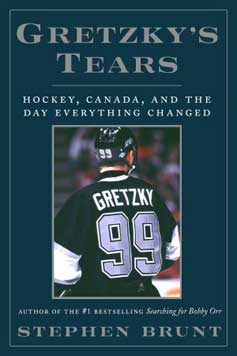
The book, Gretzky's Tears, examines the trade, from the rumblings behind the scenes during the Edmonton Oilers' dynasty to the moments leading up to the trade and even the long term effects of the trade on a country, a league, and those associated with Gretzky in any way. The author, Stephen Brunt, has penned a book about another hockey legend in Searching for Bobby Orr, so one would assume that he knows how to approach such subject matter. In Gretzky's Tears, Brunt tells a fairly detailed story of how the trade went down, the long term ramifications of the trade (e.g. the Sun Belt expansion), and how the principal owners in the trade came to the position that they did in making the trade. Overall, the book does a fairly good job of getting to the details of everything surrounding the trade, and in some cases, the participating owners in the light that they deserve. The book does tend to be biased towards the neighbors to the North, portraying them as victims and the NHL as money grabbing thieves (come to think of it, some still think this way, particularly with Gary Bettman in charge). Bias aside, the book provides a unique insight on The Trade and in some respects, the emotions behind it.
Friday, February 24, 2012
Losing Weight...the Gypsy Way
I have a hockey related piece to write about, but since I finished a book a few hours before that bit of news broke, the book review has to come first. With that in mind, there was a time when Stephen King used a pen name, that being Richard Bachman. One of the books he wrote under this name was Thinner, in which the main character Billy Halleck starts losing weight at an alarmingly rapid pace. Why does this happen, you ask? One evening, Halleck drives distracted (read: his wife was giving him a hand job) and before he could react, he hits and kills an old woman. One court case later, and Halleck is off the hook...except that the old woman he killed was the daughter of an even older Gypsy man. This man curses Halleck with a dramatic weight loss plan that soon causes Halleck to try and find ways to break this curse. Meanwhile, his wife and just about everyone associated with him begin to worry about him going insane. The turn of events, combined with two of Halleck's closest associates being cursed (one turned into a lizard and one received an extreme case of acne), forces Halleck to seek out the Gypsy and when that doesn't work out the way he planned, he turns to an old friend from New York to help him out. Can Halleck end the curse before he gets reduced to nothingness?
Thinner is one of the better books that doesn't rely heavily on violence to get its point across. All of the loose ends within the novel (e.g. Halleck's incresingly deteriorating relationship with his wife) are tied up fairly well and one of the things that allows for the novel to succeed is creating hypothetical ideas of a curse being either psychological or an unseen child growing up. It's not exceedingly long as Christine, but the results are similar in that both are good reads.
Saturday, February 4, 2012
I Got Moorcock (or Another Book Review)
It's been a while since I've had an opportunity to do a book review, and since I'm contemplating reading Paradise Lost by John Milton in preparation for Lent, this may be the last one for a while. Today, it's all about The Sailor on the Seas of Fate by Michael Moorcock, and I found this book to be a fairly easy read. The book follows Elric, who is one of the Eternal Champions in Moorcock's series of books. The Sailor on the Seas of Fate is actually the second of the Elric series, but can be read on its own, as Moorcock mentions in the introduction. This book is actually divided into three parts: the future, the present, and the past. The future part is the only one to feature the other three Eternal Champions and involves their adventure in trying put an end to Agak and Gagak. The present sees Elric in a strange land fighting against a sorcerer that guards the Crimson Gate. The past has Elric teaming with an explorer to seek out an uninhabited land for treasure. The stories are actually tied in quite well, and though the book is only 160 pages long (as is the case with the small papaerback version you see here), it keeps the reader's attention and proves to be a fairly easy read, even with the strange wording that comes with the setting of an alternate universe.
Friday, January 20, 2012
A Clockwork Orange
Today's review is actually a double, as in both a movie and book review of the same thing. As you can tell from the title, today is about A Clockwork Orange, a novel by Anthony Burgess that was later made into a movie by Stanley Kubrick. The story behind A Clockwork Orange is that the main character Alex is telling his story of how he went from the de facto leader of a small gang to a proverbial sacrificial lamb for the Ludovico Technique and back to "normal." The book actually has one more chapter added than what most American readers are used to, something that Burgess had in the beginning, but due to his American publisher's demands, had to cut the chapter out (the last one). The novel paints a dark, unforgiving world that points out some social commentary. The narration is in "Nadsat," a variation of Russian mixed with English, with influences from Cockney slang and the King James Bible. After a while, the narration can get a little annoying, but it doesn't take away from the basic story, and one of the most endearing aspects of the novel is that it forces deep thought from the reader. Many questions arise from the novel, many of them of the moral variety.
The movie stays mostly true to the novel, with a few exceptions. Where the movie differs the most from the novel is that it becomes a little more of a dark comedy (e.g. the rape scene where Alex sings "Singing in the Rain" while doing so) and relies heavily on the use of color, particularly in Frank Alexander's residence. The bright scenery in many respects clashes heavily with the overall message, which unintended or not, provides something for those who place great value on visual aspects while keeping the main story as the focus. The movie is considered a cult classic for good reason: it portrays the novel as close to perfect as it can, and it helps that Malcom McDowell's portrayal of Alex ended up being perfect.
Thursday, December 8, 2011
Playing with Fire Revisited
This book that you see in the picture is the Theo Fleury autobiography Playing with Fire. I had reviewed this in May of last year, and thought it was a great book. This past September, I re-read the book in an effort to get ready for this hockey season, and I will likely make this the go-to book before every hockey season. Why is this book being brought up again? If you haven't been reading the news lately, then you will likely have missed out on Graham James pleading guilty to sexual assault while coaching in the WHL in the 1980's. If you have read Fleury's account of what James did, then you will know just how unsettling the acts are. The relevance of the things described in the book can be applied to the Penn St. and Syracuse scandals currently ongoing, and certainly, the guilty plea from James yesterday is one step in the right direction for sexual abuse victims, past and present. There are still victims out there, and Fleury's autobiography is, and should, be a rallying point for those who have suffered, yet are afraid to come forward.
Wednesday, November 23, 2011
Survive or Be Eaten
Okay, so there's a sudden zombie outbreak and you need to know how to survive one. Where do you turn? Max Brooks thinks he has the answer, and in The Zombie Survival Guide, many of those answers are truly good ones. In this book, he gives tips on what to do and what not to do, as well as thinking about survival from a realistic point of view (e.g. automatic rapid-fire weapons work less effectively than a shotgun). From weapons to knowing your transportation and terrain, Brooks leaves no stone unturned, and he even gives examples of zombie attacks, which in turn, is an effective lead in to the follow up book World War Z. A highly recommended read (both of them).
Saturday, July 30, 2011
Lords of Chaos
In relation to the recent events of Norway, and the fact that I have had the book that I am reviewing today for ten years now, this review will be a special two part review. Lords of Chaos: the Bloody Rise of the Satanic Metal Underground was originally published in 1998 and would see a revised, updated version in 2003. The authors, Michael Moynihan and Didrik Søderlind, did a pretty good job of examining the events of the early 90's in Norway as it related to the Black Metal scene, as well as try and put a face to the ideas that drove those actions, and the subsequent thoughts. Why are there two parts to this review, you ask? This part will be devoted to my thoughts when I first bought the book and the part that will follow will be devoted to my thoughts now that I don't have the rose-colored glasses on that I did when I first read the book. So, without further ado, here is part one:
When I first picked up Lords of Chaos all those years ago, I was an impressionable youth that had recently gained some level of independence, having finished the first year of college. Being in that purgatory that existed between the rebellious years of high school and what would eventually be the calmer final years of college, finding individuality was always the thing that drove many of my decisions. So, when I picked up Lords of Chaos and leafed through the pages, the sections that I read most frequently were of the actual murders and church burnings. For obvious (and not so obvious reasons) those were the things that got my interest. I bypassed the "psychology" parts of the book because at the time, I thought it was mindless drivel that feebly attempted to get an understanding for why the things that happened. Even the origins part, the first couple chapters or so of the book, were considered by my admission at the time, total BS. All I seemed to care about in the book were the actual murders and the thoughts of those who actually in some way, shape, or form, participated in the events.
And now, the review, in the present state of mind:
In revisiting Lords of Chaos, the main idea was to see where my thoughts were then and how they have changed from that point in time. This was actually the first time that I read the book from beginning to end instead of skipping around. It's quite amazing just how much things can change from the early 90's to today. Black metal, in its core from the late 80's through early 90's, was as much about individuality as it was turning thoughts into action. Uncompromising, raw, unpleasant to the average listener, these were things that defined the genre in those days. Today, there just simply isn't a defined set of rules for black metal. Seemingly, anyone can do it nowadays, be it those stuck in the time warp or those who for the lack of a better term, have nothing better to do than to fulfill their douchebag quota. In terms of origins, it's fascinating to note that many of the bands such as Black Sabbath and Venom used the facade of Satan as a promotional tool. The infant stages of black metal had the idea of going farther than that, putting theory to practice, which led to among other things, church burnings and murder. For all intents and purposes, it seems that the black metal war against Christianity will be an eternal one, for every side that is involved in war, large or small, needs a viable enemy to justify its existence. There is no doubt that the crimes committed under the auspices of music will continue to fuel a fire within, but the more that I read into Lords of Chaos, the more I realized that every ideal has its strengths and weaknesses, and those who don't have a clear head when making such decisions will be the first ones out.
Tuesday, July 26, 2011
Insane Asylum
Book reviews can often happen at an irregular pace, and certainly, this blog's curator is no exception when it comes to that. However, since I have in fact finished a book (after three months), I can grace this blog with yet another book review. Today's selection is not only a great book, but it was also turned into an equally great book (Some say the movie is better than the book, and in the rare instance, it is true here). The Ken Kesey novel One Flew Over the Cuckoo's Nest is told through the eyes of Chief Bromden, who happens to be an inhabitant of the Asylum that is headed up by the Big Nurse, who keeps everything in order. However, that all changes when Randle Patrick McMurphy enters the asylum from a prison work program. Soon, it becomes a war of wills between the Big Nurse and McMurphy for control of the ward members.
The mechanical nature in which the asylum is run is told in such a way that the asylum is more of a machine factory than an actual insane asylum. The slow turn in which the inmates soon go from weak-minded to free-thinking is just that: slow, which furthers the McMurphy/Big Nurse storyline that builds to a fairly big finish. While the movie version gets all of the recognition (and rightfully so), the book is underrated in its narrative that presents a cold, sterile atmosphere.
Monday, May 23, 2011
Hitman
As a fan of wrestling in the 1990's, one wrestler that seemed to be near the top in that period was Bret "The Hitman" Hart. Those who have followed his career know about among other things, The Montreal Screwjob. What many may not know is all of the small things that lead to that point, as well as the things that shaped not only his career, but his life, as well. To that end, Hart has come out with his own autobiography Hitman: My Real Life in the Cartoon World of Wrestling.
As with many autobiographies, the story is told through the eyes of Bret Hart, so any objectivity can be thrown out the window. The entire story covers his early years as one of twelve children in the Hart household and goes all the way to the funeral of his father Stu Hart in 2003. Things that happened after that get a brief mention, since according to Hart, the "Hitman" character, as well as pro wrestling as he knew it, died when Stu Hart's funeral happened. The actual autobiography is divided into his life before the then-WWF, the WWF years, and everything from The Montreal Screwjob forward. Bret Hart isn't quite on the level of Mick Foley or Chris Jericho when it comes to the enjoyment factor of reading autobiographies, but Hart's main strength in reading his book is about honest emotion. From the jealousy that threatened, if not tore, the family fabric, particularly after his younger brother Owen's death, to the stories from the road in the old Stampede Wrestling days in the 1970's and 80's, Hart does his best to cover everything of importance to him. Even the interactions with other wrestlers such as Hulk Hogan, Steve Austin, and Shawn Michaels over time are covered. In many respects, Hart's autobiography reads more like a confessional than anything else, as he told stories about his unfaithfulness to his wife, and the constant up-and-down relationship that the marriage experienced, some due to that unfaithfulness, some not. Some of the bitterness towards the likes of Hulk Hogan or Triple H may have a few readers calling sour grapes, while that same bitterness could be seen as confirming what they already (claim to) know.
Overall, Hitman: My Real Life in the Cartoon World of Wrestling is a fascinating read, but like a roller coaster, be prepared to experience the gamut of emotions when reading. It's not the best wrestler autobiography out there (it took me two tries to get through it), but it definitely is worth checking out.
Subscribe to:
Posts (Atom)